Most marketing teams don't need more data. They need a clearer next move.
Allocent brings customer, funnel, retention, sentiment, and demand signals into one decision layer (a system that calculates the best next action), so teams can see where attention should go, what action matters now, and which opportunities are worth moving on first.
The problem is not visibility. It is deciding what matters first.
Most brands already have the numbers. They are spread across ad platforms, storefront data, retention tools, CRM workflows, and customer feedback. Allocent turns that scattered picture into one decision layer — a system that doesn't just show data, but calculates the best next action — so teams spend less time interpreting dashboards and more time acting on what is actually changing underneath performance.
What slows teams down is not the absence of data. It is the time and uncertainty involved in figuring out which signal matters now, which customer deserves action, and which move is worth making first.
A live score built from the signals that actually move decisions.
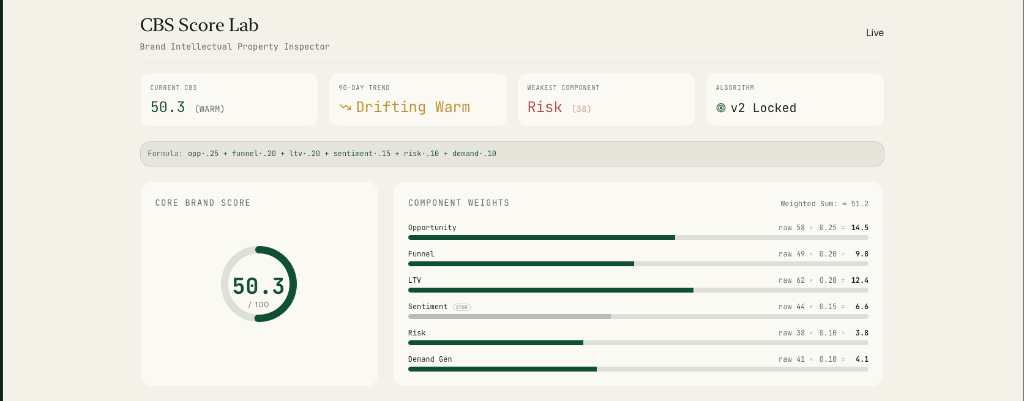
Allocent calculates a Customer Behavior Score for each customer using six active inputs: opportunity, funnel health, lifetime value, sentiment, retention risk, and demand intent. Instead of treating those signals as separate reports, the system combines them into one score that helps decide where to act first.
See how the score changes in real time.
This module shows how Allocent calculates the Customer Behavior Score for an individual customer profile. Each slider represents one live input into the model: opportunity, funnel health, lifetime value, sentiment, retention risk, and demand intent. As those inputs move, the score updates instantly.
The sliders are there to simulate changes in the customer’s current state. If demand intent increases because someone is browsing repeatedly, returning often, or leaving behind abandoned-cart signals, that input moves up. If sentiment weakens, or if retention risk starts rising, the score changes in response. The goal is to show that the score is dynamic and moves with the underlying customer context.
Each signal has a fixed weight inside the model, so not every slider affects the total equally. Opportunity has the strongest influence because it helps determine where spend and attention should go first. The other signals refine that picture by adding customer quality, funnel health, long-term value, and risk. As the sliders move, the weighted contribution ledger and final score update together, so you can see exactly what changed and why.
The score itself is not the final output. It is the decision layer underneath the next action. Once the score moves into a certain band, Allocent updates the recommended path for that customer or cohort.
Live action routing
Live action routing is how Allocent turns the score into a next step. If the score is high, the system may route that customer into an immediate opportunity or conversion-focused queue. If the score is moderate, it may shift them into nurture. If the score weakens because risk rises or sentiment falls, the system may route attention toward retention review, sentiment follow-up, or delayed action. The point is that the score is not just descriptive — it helps determine what happens next.
Score is high. System routes this customer into a conversion-focused queue.
Allocent is built for what happens after the insight.
Most tools stop at reporting. Allocent is designed to push the next decision forward — whether that means surfacing a high-value opportunity, flagging a retention risk, prioritizing sentiment follow-up, or bringing the right move to the top of the queue before it loses value.
opportunity_hunter
opportunity_hunter identifies the highest-priority upside based on live score movement, so teams can focus on the customers and cohorts where action is most likely to pay off.
Transparent evidence
The live system keeps track of which model, signal, and decision layer is contributing to the recommendation.
More decision modules are being added, but the goal is not to multiply agents for show. It is to make each decision path clearer, faster, and more reliable.
Allocent is designed to improve decision quality over time.
This creates a structural moat — an operational advantage that gets stronger automatically as the system runs. The system does not optimize around first-order efficiency alone. It learns from repeat-value patterns, customer behavior, and decision outcomes, so budget and attention can be routed toward customers who are more valuable over time, not just easier to convert once.
That changes the optimization target. Instead of chasing the cleanest short-term return, the system starts prioritizing customers and segments with stronger long-term upside.
pLTV-Adjusted ROAS
pLTV-adjusted ROAS (Return on Ad Spend adjusted for Predicted Lifetime Value) shifts the focus from short-term return to durable customer value. That means spend decisions are informed by who is likely to buy again, not just who produced a good-looking day-one number.
Privacy-safe intelligence
As the system processes decisions across different datasets, the underlying routing logic improves. Raw transaction data strictly remains inside your tenant, but the structural patterns observed allow the system to develop stronger decision quality and better value-aware routing over time.
The same system can support very different operating realities.
Solo D2C founder
For a solo operator, Allocent helps narrow attention fast. Instead of checking everything, they can see where the biggest opportunity or risk sits right now.
Scaling D2C
For a scaling brand, it helps sort signal from noise. As spend, channels, and customer segments grow, the system makes it easier to know which actions deserve priority.
Mid-market group
For mid-sized retail teams, it becomes a shared decision layer across products, channels, and customer groups. That reduces fragmentation and makes action queues easier to trust.
Enterprise multi-brand
For multi-brand operators, it creates a more consistent way to read customer value, opportunity, and risk across a larger portfolio without relying on disconnected workflows.
Allocent is being built in three layers.
Foundation — See
The current layer brings together core signals like CBS, NPS, funnel behavior, intent, demand patterns, and LTV so teams can see the state of the customer more clearly.
Decision — Prioritize
The next layer turns scoring into ranked decision queues, tighter orchestration, and stronger budget logic based on long-term customer value.
Execution — Act
The final layer is where the system moves from surfacing decisions to driving approved execution paths with far less manual coordination.
More data has not made marketing easier to run.
Most teams are still switching tabs, comparing conflicting numbers, and making budget calls with incomplete context. Allocent is being built for retail operators who need a cleaner way to decide where money, time, and action should go next.
It is built for teams that are past the point of basic reporting, but still far from having a true decision system underneath their marketing.
Start with the parts of Allocent you would want first.
Not every brand needs the same layer first. Some need better customer scoring, some need stronger churn visibility, and some need ranked action queues before anything else. This section lets you show which parts of the system matter most in your setup.
Visibility without the noise.
A note from the founder
I've run factories, sold on Blinkit, and worked retail floors under Reliance Brands. Everywhere, the same lie: the dashboard says you're winning. Your bank account disagrees.
Platform ROAS doesn't pay salaries. Margin does.
Allocent tells you where your next rupee should go — after returns, after COD cancels, after GST. Margin-true. Prediction reconciled against reality. Every decision defensible.
No vanity metrics. Just the truth about your money.